

Automotive AIoT Plant Applications for Connected Automotive Components Manufacturing
Automotive Manufacturing Plant Applications

Automotive AIoT Operational Intelligence for Connected Components Manufacturing
Automotive Components delivers AIoT-enabled operational intelligence designed specifically for connected automotive components manufacturing environments including Tier 1 supplier facilities, robotic welding lines, stamping operations, paint shops, drivetrain production, chassis systems manufacturing, body-in-white operations, and high-volume assembly ecosystems. The platform combines AI, IoT, AIoT, RFID, BLE, UWB, industrial vision systems, edge computing, industrial gateways, OPC UA connectivity, MQTT event orchestration, and real-time manufacturing analytics to improve production visibility, workforce accountability, material synchronization, and operational traceability across automotive manufacturing operations. The platform supports plant operators, manufacturing engineers, production managers, quality teams, EHS leaders.
AIoT Applications Across Automotive Components Manufacturing Environments
Automotive components manufacturing requires coordinated execution across stamping presses, robotic welding cells, paint operations, final assembly lines, supplier logistics zones, and powertrain production systems. Every production stage depends on synchronized materials, authorized personnel access, production safety compliance, and accurate part genealogy. Automotive Components supports these requirements using integrated AI, IoT, and AIoT technologies including RFID, BLE, UWB, industrial sensors, machine vision, edge gateways, OPC UA connectivity, and manufacturing data orchestration. This page outlines practical AIoT deployment applications across major automotive production environments where operational visibility directly impacts throughput, quality, compliance, and plant performance.
Stamping Operations Visibility
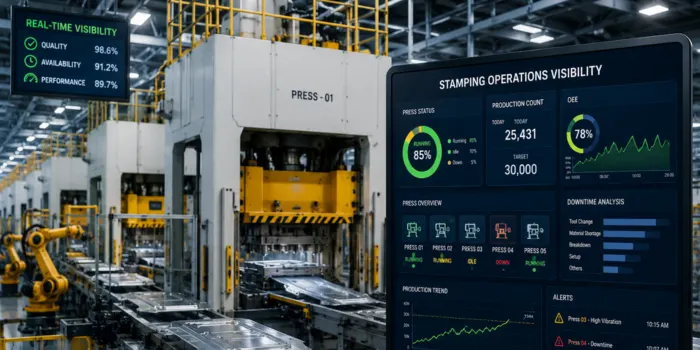
Automotive stamping operations involve progressive dies, transfer presses, blanking lines, steel coil handling systems, servo presses, and die-change workflows that require precise operational coordination. Production interruptions inside stamping plants can impact robotic welding cells, paint operations, and downstream final assembly sequencing.
Automotive Components provides AIoT-based stamping visibility using RFID tooling intelligence, BLE workforce monitoring, UWB positioning systems, edge AI analytics, industrial occupancy sensors, and connected press telemetry.
Stamping plants rely on heavy presses, tooling changeovers, coil handling systems, and synchronized material movement. Limited visibility in these environments can create bottlenecks, safety exposure, and tooling delays.
These capabilities help automotive plants improve die utilization, reduce changeover delays, and increase throughput consistency.
Automotive Components supports stamping operations through:
- Press die location visibility using RFID and UWB tooling tags
- Coil inventory movement tracking between receiving and production lines
- Workforce movement monitoring near restricted press zones
- Forklift and personnel proximity detection for safety enforcement
- Real-time press area occupancy analytics
- Tool crib access control and authorization logging
- Work-in-progress visibility between stamping cells and downstream operations
- Predictive alerting for material staging delays
Automotive Robotic Welding Intelligence
Robotic welding environments within automotive manufacturing require coordinated material flow, welding fixture availability, operator authentication, and production sequencing between body structure assemblies, chassis operations, and body-in-white manufacturing zones.
Automotive Components integrates AIoT monitoring with industrial wireless infrastructure to improve welding throughput, safety compliance, and manufacturing visibility across robotic welding cells.
Robotic welding lines demand synchronized part delivery, fixture availability, operator safety, and uninterrupted robot cell operation.
Automotive Components provides welding visibility through:
- Robot cell operator presence verification
- Restricted welding zone access enforcement
- Welding fixture and jig location intelligence
- Returnable rack tracking for inbound components
- Automated WIP progression visibility between welding stations
- Safety perimeter breach alerts using UWB positioning
- PPE compliance monitoring near robotic cells
- Real-time welding line labor analytics
- Production queue visibility for robotic workcells
Manufacturers use these insights to improve line balance, reduce idle time, and strengthen production safety controls.
Paint Shop Monitoring
Automotive paint shops require environmental consistency, contamination prevention, controlled personnel movement, and synchronized body carrier tracking throughout pretreatment, electrocoat, primer, basecoat, and clearcoat operations.
Automotive Components supports connected paint operations using industrial IoT sensors, BLE environmental monitoring, RFID carrier tracking, and AI-powered operational analytics.
Paint operations require environmental stability, strict contamination controls, and coordinated vehicle body flow.
Automotive Components supports paint shop operations through:
- Personnel movement monitoring in controlled paint environments
- Booth access governance and authorization control
- Environmental sensor monitoring for temperature, humidity, and airborne conditions
- Paint line work-in-progress tracking
- Carrier and hanger traceability across paint stages
- Hazard zone safety alerts for chemical handling areas
- Material replenishment visibility for coatings and consumables
- Quality event correlation with environmental conditions
This supports process stability, contamination reduction, and better production accountability.
Final Assembly Tracking
Final automotive assembly operations depend on synchronized line-side inventory, takt-time coordination, sequence validation, torque tool accountability, workforce coordination, and accurate work-in-progress progression across high-volume assembly lines.
Automotive Components delivers AIoT-enabled assembly visibility supporting lean manufacturing operations, digital shopfloor coordination, and automotive sequencing intelligence.
Final assembly requires accurate sequencing, component availability, labor coordination, and station-by-station execution.
Automotive Components enables:
- Assembly cell workforce visibility
- Line-side inventory monitoring for critical components
- Kanban replenishment intelligence
- Batch sequence tracking across assembly stages
- Real-time queue analytics between stations
- Smart operator identification and digital labor logs
- Tool utilization visibility for torque tools and fixtures
- Exception alerts for delayed or missing components
Assembly leaders gain improved takt-time adherence and stronger operational transparency.
Work-in-Progress Traceability Applications
Work-in-progress visibility is essential in automotive manufacturing where intermediate inventory can quickly become hidden.
Automotive Components enables:
- Real-time WIP tag monitoring
- Route progression validation
- Production buffer visibility
- Assembly queue intelligence
- Lot movement tracking
- Process handoff confirmation
- Digital production timestamps
- Automated exception escalation
This improves production continuity and reduces hidden inventory risk.
Powertrain Components Manufacturing Analytics
Powertrain production involves machining, subassembly, quality checkpoints, and serialized component traceability.
Automotive Components supports powertrain manufacturing through:
- Serialized component genealogy tracking
- Workstation occupancy monitoring
- Machine area personnel visibility
- Tool and fixture location intelligence
- Lot-to-batch production correlation
- Production route verification
- Material movement visibility between machining cells
- Recall readiness through full digital traceability
These capabilities support quality assurance and faster root-cause analysis.
Production Throughput Monitoring
Plant throughput depends on continuous visibility across all manufacturing zones.
Automotive Components delivers throughput intelligence by combining:
- Live production movement data
- Station dwell-time analytics
- Queue accumulation alerts
- WIP velocity tracking
- Bottleneck identification dashboards
- Shift performance comparisons
- Multi-line productivity analytics
- Exception-based operational alerts
Operations teams can identify delays earlier and respond faster.
Tooling Utilization Visibility
Tooling availability directly affects uptime.
Automotive Components helps plants monitor:
- Press dies
n- Welding fixtures - Torque tools
- Mobile maintenance assets
- Calibration tool movement
- Tool room access events
- Idle tool detection
- Tool utilization analytics
Manufacturers reduce search time and improve asset accountability.
Automotive Material Flow Intelligence
Material movement across receiving, warehouse, supermarkets, line-side zones, and outbound logistics requires precision.
Automotive Components supports:
- Raw material flow tracking
- Finished goods staging visibility
- Kanban replenishment intelligence
- Smart bin monitoring
- AGV coordination support
- Rack movement analytics
- Warehouse occupancy intelligence
- Line feed optimization dashboards
These insights improve material availability and reduce disruptions.
AI Safety Monitoring
Safety remains a priority in automotive plants where forklifts, robots, presses, and hazardous materials operate simultaneously.
Automotive Components supports plant safety through:
- Workforce location awareness
- Emergency muster tracking
- PPE compliance analytics
- Restricted area intrusion alerts
- Forklift proximity monitoring
- Visitor access governance
- Contractor movement analytics
- Automated safety event logging
This strengthens compliance and incident response readiness.
Automotive Production Analytics
Automotive Components transforms factory event data into actionable production intelligence.
Analytics include:
- Shift productivity trends
- Labor utilization metrics
- Station throughput comparisons
- Production delay root-cause analysis
- Inventory velocity analytics
- Downtime correlation insights
- Quality trend visibility
- Multi-plant benchmarking
Decision-makers gain operational clarity across facilities.
Factory Asset Intelligence
Automotive plants operate thousands of movable and fixed assets.
Automotive Components tracks:
- Returnable transport items
- Mobile tooling
- Industrial carts
- Production containers
- Forklifts
- AGVs
- Maintenance equipment
- Calibration assets
This improves asset availability and reduces losses.
Industrial Sensor Applications
Connected sensors provide the operational foundation for AIoT environments.
Supported sensor applications include:
- Occupancy sensing
- Environmental monitoring
- Vibration sensing
- Energy metering
- Door state monitoring
- Bin level sensing
- Machine condition telemetry
- Utility system visibility
Sensor data feeds plant-wide operational dashboards.
Connected Manufacturing Operations
Automotive Components connects workforce, assets, materials, and systems into one operational layer.
Integrated environments include:
- MES platforms
- ERP systems including SAP
- SCADA environments
- OPC UA industrial systems
- MQTT event pipelines
- Edge gateways
- Warehouse systems
- Quality systems
This creates unified manufacturing intelligence.
Edge AI Production Monitoring
Edge AI supports low-latency manufacturing environments where local decision-making is required.
Use cases include:
- Local anomaly detection
- Machine vision event processing
- Safety alert generation
- Sensor fusion analytics
- Offline operational continuity
- Immediate production event response
This improves resilience and response speed.
BLE Beacon Administration for Workforce and Facility Visibility
BLE beacon infrastructure supports workforce positioning analytics, occupancy intelligence, production zone monitoring, contractor visibility, and manufacturing movement analytics throughout automotive factories.
Automotive Components supports BLE manufacturing operations through:
- BLE beacon lifecycle administration
- Signal calibration management
- Workforce movement analytics
- Occupancy event monitoring
- Presence detection orchestration
- Beacon battery diagnostics
- Manufacturing zone visibility
- Contractor movement intelligence
- Restricted area proximity analytics
- Factory occupancy telemetry
Automotive manufacturing environments commonly deploy BLE infrastructure within:
- Final assembly lines
- Paint shop operations
- Welding production zones
- Maintenance corridors
- Tool storage rooms
- Supplier logistics staging areas
- Forklift operating lanes
- Manufacturing safety zones
BLE workforce visibility systems support production coordination while improving industrial safety governance and manufacturing operational awareness.
Industrial Wireless Deployments
Automotive manufacturing facilities require multiple industrial wireless technologies to support workforce visibility, parts traceability, tooling monitoring, machine telemetry, environmental sensing, and production coordination.
Automotive Components supports hybrid industrial wireless deployments designed for demanding automotive factory environments.
Automotive manufacturing depends on multiple wireless technologies selected by use case.
Automotive Components supports:
- RFID for traceability and asset identification
- BLE for proximity and low-cost tracking
- UWB for high-precision locationing
- Wi-Fi for device connectivity
- Cellular for distributed logistics visibility
- LoRaWAN for extended sensor coverage
Automotive Components enables:
- VIN-linked component history
- Supplier lot correlation
- Process-stage timestamps
- Quality hold visibility
- Defect event traceability
- Root-cause analysis support
Real-Time Manufacturing Operations
Automotive Components supports continuous operational awareness through:
- Live dashboards
- Role-based alerts
- Mobile plant visibility
- Supervisor analytics
- Event-driven notifications
- Shift handoff visibility
Multi-Plant Operational Intelligence
Automotive Components enables enterprise visibility through:
- Cross-site KPI comparison
- Standardized reporting
- Shared operational benchmarks
- Centralized governance
- Fleet-wide device management
- Enterprise-wide traceability analytics
Automotive AIoT Technologies Supporting Production Intelligence
Automotive Components supports connected automotive manufacturing environments using:
- RFID systems for serialized component traceability and returnable rack tracking
- BLE infrastructure for workforce visibility and proximity monitoring
- UWB positioning for high-precision tooling and personnel location intelligence
- Industrial vision systems for production monitoring and process validation
- Edge AI gateways for localized analytics and low-latency operational response
- OPC UA integration for industrial equipment connectivity
- MQTT event streaming for manufacturing telemetry pipelines
- Smart environmental sensors for paint shop and facility monitoring
- Wearable safety devices for workforce accountability
- Industrial occupancy analytics for production coordination
These technologies support automotive manufacturers seeking operational visibility across stamping, welding, paint, assembly, logistics, and powertrain operations.
Why Automotive Manufacturers Choose Automotive Components
Automotive Components was built from deep industrial IoT deployment experience developed through decades of work supporting thousands of IoT projects across industrial environments. The organization benefits from long-standing engineering experience, strong quality assurance practices, advanced R&D investment, and technical leadership from highly qualified domain experts. Teams support deployments remotely and onsite for manufacturers requiring practical operational outcomes rather than theoretical technology demonstrations.
Practical Applications Across Automotive Plants
Automotive Components supports deployment across:
- Tier 1 automotive component plants
- Tier 2 parts manufacturers
- Stamping facilities
- Welding plants
- Paint shops
- Final assembly operations
- Powertrain production facilities
- Supplier logistics hubs
- Multi-site automotive manufacturing enterprises
Automotive manufacturing leaders use Automotive Components to improve workforce visibility, access governance, production traceability, work-in-progress monitoring, inventory synchronization, tooling intelligence, operational safety, and AIoT-enabled production analytics across connected automotive factory environments. The platform supports real-time operational intelligence for stamping operations, robotic welding, paint shops, body-in-white manufacturing, final assembly, supplier logistics, and powertrain production facilities using industrial AIoT technologies tailored specifically for automotive manufacturing operations.
